


You've seen the price. Maybe it was on a comparison site, maybe it came in an email, maybe a neighbor mentioned it. And your first instinct was probably the right one: is that actually what I'll pay?
In most cases, the answer is: it depends. The per-gallon price you see advertised is a starting point, not a final number. What you actually pay depends on your order size, how you pay, what kind of delivery service you're on, and whether there are fees buried in the fine print you haven't found yet.
Here's what's really going on behind that number — and what it means for Nassau County homeowners specifically.
Heating Oil Prices Today: What You're Actually Looking At
The price you see quoted for heating oil today is almost always based on a benchmark — typically the New York Harbor futures price traded on the NYMEX, adjusted for local distribution costs and whatever margin the supplier builds in. It moves daily, sometimes by several cents, based on crude oil markets, weather forecasts, and regional inventory levels.
That daily movement is real. But it's only part of the picture. The number that actually matters is your all-in cost per gallon after delivery fees, payment method surcharges, and any service contract costs are factored in. Those extras can add 30 to 50 cents per gallon to what you thought you were paying — and for an 800-gallon household, that's a significant difference over a winter.
What Makes Up the Per-Gallon Price of Heating Oil?
There's a breakdown behind every price quote that most companies don't explain, and it's worth understanding. According to the U.S. Energy Information Administration, crude oil accounts for roughly 53% of the final price of home heating oil. Refinery processing costs make up about 15%, and distribution and marketing — which includes the truck, the driver, the company's overhead, and their margin — accounts for approximately 37%.
When crude oil prices jump, your heating oil price jumps with it, regardless of which company you use. That's not a supplier problem — it's a market reality. The part that does vary by supplier is the distribution and marketing slice. That's where pricing decisions, fee structures, and delivery model choices actually affect what lands on your bill.
This is why prices can vary by 30 cents or more per gallon between two companies delivering to the same Nassau County ZIP code. They're working from the same crude oil benchmark. The difference is in how they structure their costs and what they pass along to you.
One factor that's the same for every supplier in Nassau County: the New York State B5 biodiesel requirement. All heating oil sold in downstate New York — including Nassau County, Suffolk County, New York City, and Westchester — must contain at least 5% biodiesel. This isn't an optional upgrade or a premium product. It's the legal minimum. If you see a reference to "B5" or "biofuel blend" on an invoice or product description, that's not something extra you're being charged for — it's simply what heating oil is in this part of New York.
Understanding these components matters because it changes how you evaluate a price quote. A company offering $3.10 per gallon with a $75 delivery minimum and a credit card surcharge may end up costing more than a company quoting $3.25 with no add-ons. The advertised number is the beginning of the conversation, not the end of it.
Why Your Order Size Affects the Price Per Gallon
This is one of the most practical things a Nassau County homeowner can know about heating oil pricing, and it rarely gets explained clearly. The per-gallon price you're quoted isn't fixed — it typically drops as your order size increases. That's not a discount in the promotional sense; it's just how fuel distribution economics work. Larger orders spread the fixed delivery cost across more gallons, so the effective per-gallon rate is lower.
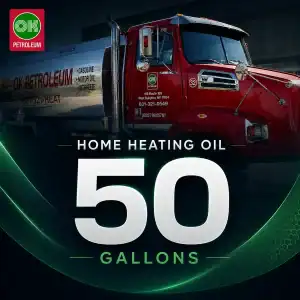
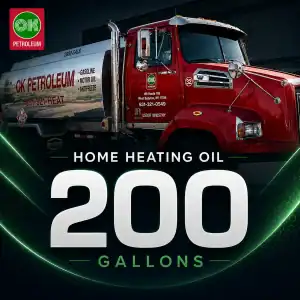
A 50-gallon order typically costs significantly more per gallon than a 200-gallon order from the same supplier. The difference can be substantial enough that ordering a full tank when you're at 30% capacity is often cheaper per gallon than ordering a small top-off when you're at 15%. If you have the tank space and the budget, ordering more at once tends to work in your favor.
This is also why the "cheapest price" headline on a comparison site can be misleading. That rate is often shown for a specific order size — sometimes 100 gallons, sometimes 150 — and the price changes meaningfully above and below that threshold. Always check what order size the quoted price applies to before you compare across suppliers.
Heating oil prices in the Northeast tend to be lower in the off-season — roughly April through September — when demand drops and suppliers have more flexibility. Homeowners who pre-buy or lock in a price during the summer often pay less per gallon than those who order during peak winter demand. Budget plans and price protection plans exist specifically to help with this: they let you smooth out the seasonal price swings by either locking in a rate or spreading your costs across the year.
Heating Oil Prices on Long Island: Why Nassau County Is Its Own Market
Long Island is one of the most active home heating oil markets in the country. More than 337,000 Long Island homes use heating oil as their primary heating fuel — about 34% of all residences. In Nassau County specifically, 22 oil companies are actively competing for that business, and last winter alone, nearly 456,000 gallons of heating oil were delivered to Nassau County homeowners.
That density of both demand and competition matters. It means Nassau County buyers have real options — but it also means the pricing landscape is genuinely variable, and the difference between a well-informed purchase and a rushed one can add up over a season.
The Hidden Fee Problem That Costs Nassau County Homeowners Every Winter
A significant portion of the distrust Long Island homeowners feel toward heating oil companies is earned. Not because suppliers are universally dishonest, but because certain practices in this industry have become normalized that shouldn't be.
The most common one involves automatic delivery programs. The concept is legitimate and genuinely useful — a supplier monitors your usage patterns and schedules deliveries before your tank runs low, so you never wake up to a cold house. But in practice, many automatic delivery programs are bundled with service contracts that require you to buy exclusively from that company. The cost of that contract — roughly $0.60 per gallon, according to industry analysis — gets embedded in the per-gallon price rather than listed as a separate line item. For a household that uses 800 gallons in a winter, that's close to $480 in costs that never appear anywhere on the quote.
There's also the credit card surcharge issue. A New York Attorney General investigation found 14 oil companies in Suffolk County charging illegal credit card surcharges to customers. These weren't disclosed upfront — they showed up on the bill after delivery. Nassau County buyers aren't immune to the same practice, and the NYC Department of Consumer and Worker Protection explicitly advises homeowners to get a written contract, check for price-changing clauses, and look for hidden minimum purchase requirements before committing to any supplier.
Automatic delivery is a genuinely good option for busy households, particularly in a commuter county like Nassau where many homeowners are away during the day and don't want to monitor tank levels. The point is to know what you're agreeing to before you sign anything. Ask specifically: is there a service contract? What does it require? Are there delivery fees, minimum order requirements, or credit card surcharges? A supplier who's straightforward about those answers is one worth trusting.
Automatic Delivery vs. Will-Call: Which One Actually Works for You?
This is a decision that affects both your convenience and your cost, and it's worth thinking through rather than defaulting to whatever the supplier recommends.
Automatic delivery makes the most sense if you want complete hands-off management of your fuel supply. We use predictive models based on your historical usage and current weather to estimate when your tank will need a refill and schedule the delivery proactively. You don't have to monitor your gauge, remember to call, or worry about running out during a cold stretch. For Nassau County homeowners who commute into the city, travel frequently, or simply don't want one more thing to track, it's a genuinely practical option — as long as the program doesn't come with a contract that locks you in or inflates your per-gallon cost.
Will-call, or on-demand delivery, puts the control back in your hands. You decide when to order, how many gallons you want, and you pay at the time of delivery. There's no contract, no commitment, and no obligation to buy from the same company every time. If prices drop mid-season or you find a better rate elsewhere, you can act on it. The trade-off is that you're responsible for monitoring your tank and ordering before you run low — which requires a bit more attention but gives you more flexibility over your costs.
We offer both at OK Petroleum Distribution, and we don't push one over the other. Some customers have been on automatic delivery with us for years and wouldn't change it. Others prefer the control of will-call and order online when they're ready, specifying exactly how many gallons they want and paying through our website or mobile app. What matters is that you're choosing based on what actually fits your household — not because a contract made the decision for you.
Our will-call service has no contracts and no extra fees. The price you see when you order is the price you pay. We've been doing this since 1976, and we've seen what happens when customers feel like they got a bait-and-switch. It's not how we operate.
Getting a Fair Heating Oil Price in Nassau County Starts With Knowing What to Ask
The per-gallon number you see on a website or comparison tool is a starting point. What it actually costs you depends on your order size, your delivery model, your payment method, and whether there are fees that don't show up until the truck leaves your driveway. Nassau County has 22 oil companies competing for your business — which means you have real leverage, but only if you know what questions to ask.
Ask about delivery fees. Ask whether automatic delivery comes with a service contract. Ask whether the quoted price changes based on how you pay. Those three questions will tell you more about a supplier than any headline rate.
If you're ready to see what a straightforward price actually looks like — no contracts on will-call orders, no hidden surcharges, and an online ordering system where you specify exactly what you want — reach out to OK Petroleum Distribution at (631) 321-0549 or place an order directly through our website.