



You just bought a house in Nassau County and noticed there's an oil tank in the basement. Or maybe you've been on oil heat for years but you've never actually understood how the delivery side of it works — you just wait until the gauge gets low and start hoping. Either way, you're not alone. A lot of homeowners on Long Island are in exactly the same spot.
This page is here to change that. We'll walk you through how heating oil delivery service actually works — the two main delivery models, what happens on delivery day, how to pay, and what to do if you ever run low in the middle of a cold snap. By the time you're done reading, you'll know enough to make a confident decision.
How Home Oil Suppliers Deliver Heating Oil to Your Tank
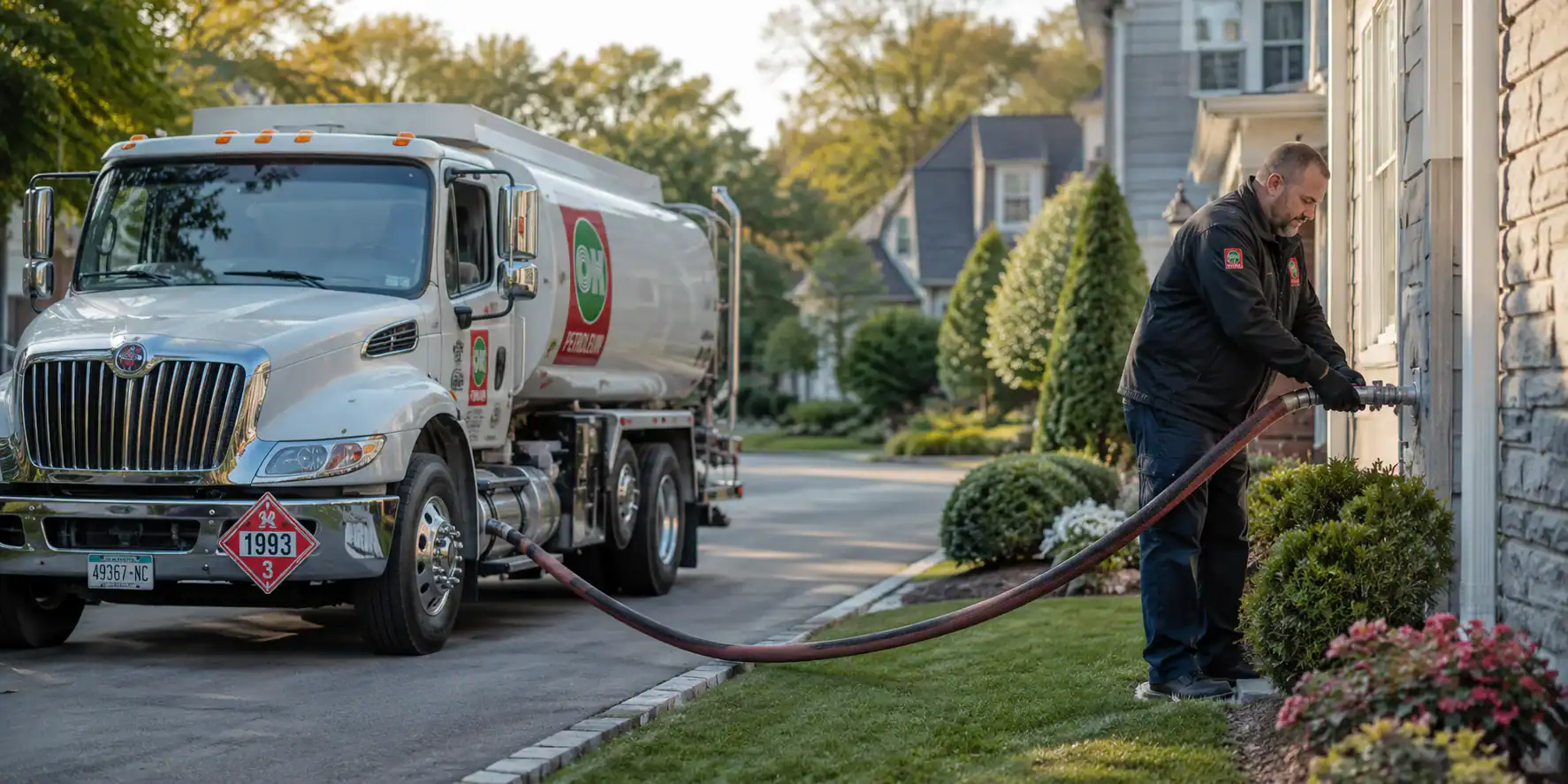
The basic process is simpler than most people expect. A delivery truck pulls up to your home, our driver locates the fill pipe on the outside of your house — usually near the foundation — and pumps heating oil directly into your tank. You don't need to be home. You don't need to open a door or move anything. The fill pipe and vent pipe are both accessible from outside, which means the entire delivery can happen while you're at work, running errands, or asleep.
Once the tank is filled, the driver records exactly how many gallons were delivered and leaves a ticket. That's the whole physical process. What varies is how you get to that point — specifically, how the delivery gets scheduled in the first place.
What Is Automatic Heating Oil Delivery and How Does It Work?
Automatic delivery is exactly what it sounds like — we monitor your usage and schedule deliveries before you run low, without you having to do anything. But the way it actually works is worth understanding, because it's more precise than most people realize.
We use predictive computer models that factor in your home's heating history, the size of your tank, the efficiency of your oil burner or boiler, and the current and forecasted weather. When those calculations indicate your tank is approaching the 25 to 30 percent mark, we schedule a delivery. The goal is that you never get close to empty — and never have to think about it.
This model works especially well for Nassau County homeowners who heat their homes consistently through the winter and don't want to track a gauge or remember to call. It's also a strong option if you travel frequently or have a second home you're not always watching. The system is doing the monitoring for you.
One thing worth knowing: automatic delivery doesn't mean you lose visibility. You'll know a delivery is coming, and if you ever want to adjust timing or have questions about your usage, you can reach us directly at (631) 321-0549. The convenience is the point, but you're never out of the loop.
For homeowners who had a bad experience with running out of oil — that moment of turning up the thermostat and realizing nothing is happening — automatic delivery is the most direct solution. It's designed specifically to prevent that scenario.
What Is Will-Call (On-Demand) Heating Oil Delivery?
Will-call delivery puts you in full control. You decide when to order, how many gallons you want, and when you want the truck to come. There's no monitoring program running in the background — you're the one watching the gauge and placing the order when you're ready.
For a lot of Nassau County homeowners, this is actually the preferred setup. If you run a tight household budget and want to control exactly how much you spend and when, will-call gives you that. You can order 50 gallons when prices look favorable, or 200 gallons when you want to stock up before a cold stretch. The choice is yours.
We've built the ordering process to be as easy as possible. You can place a will-call order through our online ordering system from your computer or phone, or download our mobile app on iOS or Android and handle it in a few taps. You specify the exact number of gallons you want, pay online, and we take it from there. No phone tag, no waiting on hold.
One concern we hear from homeowners considering will-call is the fear of running dry — especially during a nor'easter or a stretch of single-digit temperatures. That's a real risk if you let the tank get too low before ordering. The general rule of thumb is to reorder when your gauge hits the quarter-tank mark. Don't wait for the needle to drop below that. If you do find yourself in an emergency, we offer 24/7 emergency oil delivery, including nights and holidays.
There are no contracts required for will-call service and no extra fees for ordering on demand. You order when it works for you, and that's it.
Finding Reliable Local Heating Oil Suppliers in Nassau County
Nassau County has no shortage of oil suppliers. Price-comparison sites, aggregators, and COD-only companies all compete for the same customers, and it can be hard to tell them apart. Price matters — we know that, and Nassau County homeowners are some of the most price-aware buyers on Long Island. But price is only one piece of the picture.
What you're really evaluating is whether a supplier will show up reliably, be reachable when something goes wrong, and still be operating next season. That's where longevity and local roots actually mean something. We've been delivering heating oil to Nassau County and Suffolk County homes since 1976 — nearly 50 years — as a family-owned and operated business. That's not a marketing line. It's just the reality of what it takes to stay in this business on Long Island for that long.
Heating Oil Budget Plans: How to Spread Out the Cost
One of the things that catches Nassau County homeowners off guard is the size of a heating oil bill in January or February. You've been using oil steadily since October, and then a big delivery hits right when winter expenses are already piling up. A budget plan is designed to smooth that out.
Here's how it works: at the start of the heating season, we calculate an estimated annual fuel cost based on your home's usage history. That total gets divided into equal monthly payments, which you pay throughout the year — including the warmer months when you're not using much oil at all. The idea is that your heating costs feel more like a regular utility bill instead of a seasonal spike.
Budget plans are typically set up during the summer months, before the heating season begins. If your costs at the end of the year come in higher or lower than the estimate, there's a reconciliation at the close of the season. It's a straightforward system, and for homeowners who prefer predictable monthly expenses, it's genuinely useful.
This isn't a plan just for people who are stretched thin financially — it's a cash-flow tool that works for anyone who'd rather not absorb a large bill in the middle of winter. A lot of our longer-term customers in communities like Levittown, Massapequa, and Merrick have been on budget plans for years specifically because it simplifies their household finances.
Heating Oil Payment Plans: What Are Your Options?
Beyond the budget plan, there are a few other ways to handle payment for heating oil delivery service, and it's worth knowing what's available before you set up your account.
Prepayment lets you lock in a price per gallon before the heating season begins. You pay upfront for a set number of gallons, and that price is fixed regardless of what the market does over the winter. If prices rise — which they did by 6.15% since the start of 2025, according to the U.S. Energy Information Administration — prepayment can work in your favor. The tradeoff is that you're committing to a quantity and price before the season plays out.
A price protection plan is a middle-ground option. Rather than prepaying, you pay as deliveries happen, but your per-gallon cost is capped at a set ceiling. If market prices go above that cap, you're protected. If they stay below it, you pay the lower market rate. It's a hedge, essentially — less commitment than prepayment, more protection than paying straight market price.
For will-call customers, cash-on-delivery (COD) is also an option. Payment is made at the time of delivery, which keeps things simple and requires no advance commitment. Online payment is accepted through our ordering system, so you're not dealing with checks or cash on delivery day.
The right payment approach depends on your financial preferences and how much price risk you're comfortable with. If you're not sure which option fits your situation, we're happy to walk through it — call us at (631) 321-0549 and we can talk through what makes sense for your household.
Choosing a Heating Oil Delivery Service That Works for Your Home
The mechanics of heating oil delivery aren't complicated once you understand them. Oil goes from the truck into your tank through a fill pipe outside your home, on a schedule that's either managed for you automatically or placed by you on demand. The bigger decision is which setup fits your life — and that depends on how much you want to be involved, how you prefer to pay, and how much trust you're willing to extend to a supplier.
In Nassau County, where about 130,000 households still rely on heating oil and 65 million gallons were delivered in a single winter, getting that decision right matters. The supplier you choose will be showing up at your home multiple times a year, and you want to know they'll be there when it counts — including at 2 a.m. in January if something goes sideways.
We've been doing this on Long Island since 1976, and we're A+ rated by the Better Business Bureau. If you're ready to set up service or just want to ask a few questions before you commit to anything, reach out to OK Petroleum Distribution. No contracts required to get started.