


There's a particular kind of dread that comes with checking your oil gauge in October and realizing it's lower than you thought. You do the math in your head. You're not sure if it's enough. And now you're thinking about it every day until you finally call someone.
That moment is entirely avoidable. Nassau County winters don't give much warning — one nor'easter can flip your consumption overnight — but the good news is that a little prep in September puts you in a completely different position than most of your neighbors. Here's what to actually do before the cold arrives.
How to Read Your Heating Oil Tank Gauge (And Why It's Probably Lying to You)
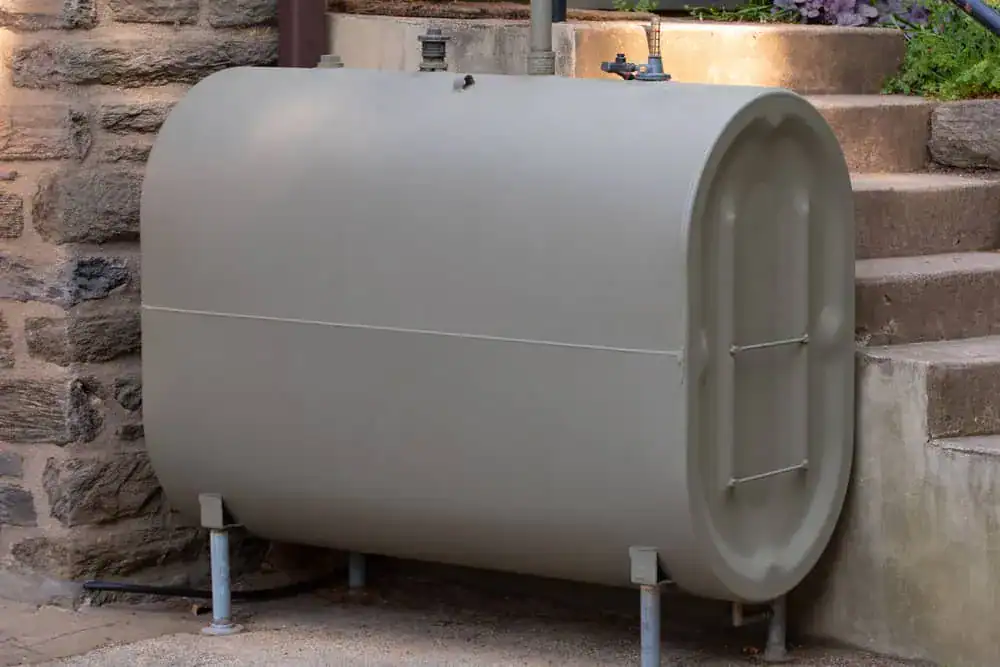
The float gauge on top of your oil tank looks simple enough — a little dial with F, ¾, ½, and ¼ marked on it. But here's the thing most people don't realize: that gauge is not reading a perfectly cylindrical container. Residential oil tanks have rounded bottoms, which means the gauge is not linear. The distance between ½ and ¼ takes much longer to travel than the distance between ¼ and empty.
In practical terms, that means a gauge reading ¼ can feel like you have time — and you don't. If you're used to watching your tank drop slowly from full to half, don't assume the bottom quarter behaves the same way. It doesn't. The last stretch goes fast, especially during a cold snap when your system is running hard.
What Does ¼ Tank Actually Mean in Gallons?
The most common residential oil tank in Nassau County holds 275 gallons. A quarter of that is roughly 70 gallons. That sounds like a reasonable cushion until you factor in how much a typical home burns during a Long Island winter.
On a cold day — and we're talking the kind of January stretch where temperatures sit in the low 30s — an average single-family home uses somewhere between 5 and 10 gallons of heating oil per day. At 5 gallons a day, 70 gallons gives you about two weeks. At 10 gallons a day, you're looking at a week, maybe less.
Before you account for the fact that your furnace or boiler will actually shut off before the tank reaches true empty. Most systems stop running when the oil level drops to about four inches — roughly 32 gallons — because the fuel pickup can't draw from the very bottom of the tank.
So when your gauge reads ¼, you're not two weeks from empty. You might be a week from your furnace locking out. That's why the industry-standard recommendation is to call for a delivery when you hit 25% to 30% — not when you hit the bottom.
There's also a less-discussed problem with letting levels drop too low: sediment. Over time, residue settles at the bottom of every tank. When the oil level gets very low, that sediment gets drawn into the fuel line. It can clog your filter, stress your oil pump, and reduce efficiency even after you've refilled.
Add to that the condensation that forms in a tank with a lot of empty air space, and you've got a recipe for rust and sludge that shortens the life of your equipment. Your gauge is giving you less time than it looks like, and the consequences of running it too low go beyond just running out of heat.
What Happens If Your Oil Tank Actually Runs Dry?
Running out of heating oil is not just an inconvenience — it creates a specific mechanical problem that a delivery alone won't fix. When the tank empties completely, air gets into the fuel line. Your burner can't restart on its own once that happens.
Before your heat comes back on, a technician needs to bleed the fuel line and relight the burner — a service call that's separate from the delivery itself. This is called a prime-and-restart, and it's one of those things that never comes up until it's happening to you at 9 p.m. on a Tuesday in February.
You've called for emergency delivery, the oil arrives, and then nothing happens because the furnace still won't run. Now you're waiting for a second appointment. For Nassau County homeowners with elderly family members or young children in the house, that gap matters. A home that loses heat during a cold snap doesn't stay warm for long — especially in older construction, which makes up a significant share of the housing stock in towns like Levittown, Massapequa, and Merrick.
The fix is straightforward: don't let the tank run dry in the first place. But if you do, know that you'll need both a delivery and a service call, and plan accordingly. Having a relationship with a fuel company that offers both — delivery and technical support — before you're in that situation is worth far more than scrambling to find someone at the last minute.
Repeated runouts also accelerate wear on your filter and oil pump. These aren't catastrophic failures on their own, but they add up. Keeping your tank above 25% isn't just about staying warm tonight — it's about protecting equipment that costs real money to replace.
Heating Oil Payment Plans: How Nassau County Homeowners Manage Winter Costs
One of the biggest stressors around heating oil isn't the cold — it's the bill. Heating oil prices fluctuate with the market, and a single delivery in the middle of a January cold snap can hit hard if you haven't planned for it. The good news is that payment options exist specifically to smooth that out.
At OK Petroleum Distribution, we offer three ways to handle the cost side of heating oil: a prepayment plan, a budget plan, and a price protection plan. Each one is built for a different kind of household situation, and understanding the difference can save you a lot of financial stress over the course of a winter.
How Does a Heating Oil Budget Plan Work?
A budget plan is designed to take the unpredictability out of your heating bill. Instead of paying a large amount per delivery during peak winter months, you spread your estimated annual fuel cost across equal monthly installments — typically over 10 or 11 months. The math is based on your home's typical consumption, and the goal is a consistent, predictable payment you can actually plan around.
For Nassau County homeowners on a fixed income, or anyone managing a tight monthly budget, this matters a lot. Heating oil prices tend to spike in winter, which is exactly when you're using the most fuel. A budget plan separates your payment schedule from the market's timing, so you're not absorbing the full cost of a cold February in a single bill.
The prepayment plan works differently — you pay for a set amount of oil upfront, often at a locked-in price, before the season begins. This can work well if you want to buy early when prices are lower, though it requires more capital upfront. September is often a good window for this, since prices tend to be more favorable before peak demand kicks in.
The price protection plan is built for homeowners who want a ceiling on what they'll pay per gallon regardless of what the market does. It's particularly useful during periods of price volatility — if global supply tightens or a brutal winter drives demand up, you're insulated from the spike. There may be a modest premium for this protection, which is worth weighing against the peace of mind it provides.
None of these plans require a long-term contract with us. That's worth saying plainly, because a lot of homeowners assume that any kind of structured plan comes with strings attached. It doesn't have to.
Automatic Delivery vs. Will-Call: Which One Is Right for You?
This is the question most Nassau County homeowners don't know to ask — because most of them don't realize they have a real choice.
The standard assumption is that you either sign up for automatic delivery with a full-service company (usually with a contract, sometimes with a premium) or you go the COD route and monitor your own tank. Neither option feels perfect. Automatic delivery sounds convenient but locked-in. Will-call sounds flexible but exhausting to manage.
What most people don't know is that those aren't the only two options. We offer automatic delivery with no contract and no extra fees. Our system uses degree-day tracking — a predictive model based on outdoor temperatures and your home's consumption history — to schedule deliveries before your tank gets low. You don't have to watch the gauge. You don't have to remember to call. The oil arrives before you need it.
For busy Nassau County households — and with an average commute time of 36 minutes each way, most people here are busy — this is the version of automatic delivery that actually makes sense. You get the hands-off convenience without giving up the flexibility to switch providers if you ever want to.
If you'd rather stay in control of your own ordering, our will-call service lets you specify exactly how many gallons you want and place the order online or through our mobile app. Same-day delivery is available across Nassau County for orders placed before mid-afternoon, and most deliveries arrive within a few hours. Nassau County's density works in your favor here — our trucks can cover more ground in less time than in more rural parts of Long Island, which means faster turnarounds when you need them.
The right choice depends on your household. If you travel frequently, tend to forget about the tank, or just want one less thing to manage, automatic delivery is the better fit. If you like to track your usage, shop around, or order in specific amounts, will-call gives you that control. Either way, you're not locked in.
The Best Time to Get Your Oil Situation Sorted Is Before You Need To
Everything in this guide comes down to one idea: Nassau County winters are not forgiving of last-minute decisions. A gauge that reads ¼ gives you less time than it looks like. A tank that runs dry creates problems an oil delivery alone won't solve. And a heating bill that arrives in January with no plan behind it hits harder than it needs to.
The homeowners who sail through winter without drama aren't lucky — they just made a few decisions in September that everyone else puts off until it's too late. Check your gauge now. Understand what the numbers actually mean. Decide whether automatic delivery or will-call fits your life better. And if you want a payment plan that smooths out the cost, ask about it before the season starts, not in the middle of it.
If you're ready to get set up before the first cold snap hits, OK Petroleum Distribution has been helping Long Island homeowners do exactly that since 1976. Give us a call at (631) 321-0549 and we'll figure out what works for your home.